
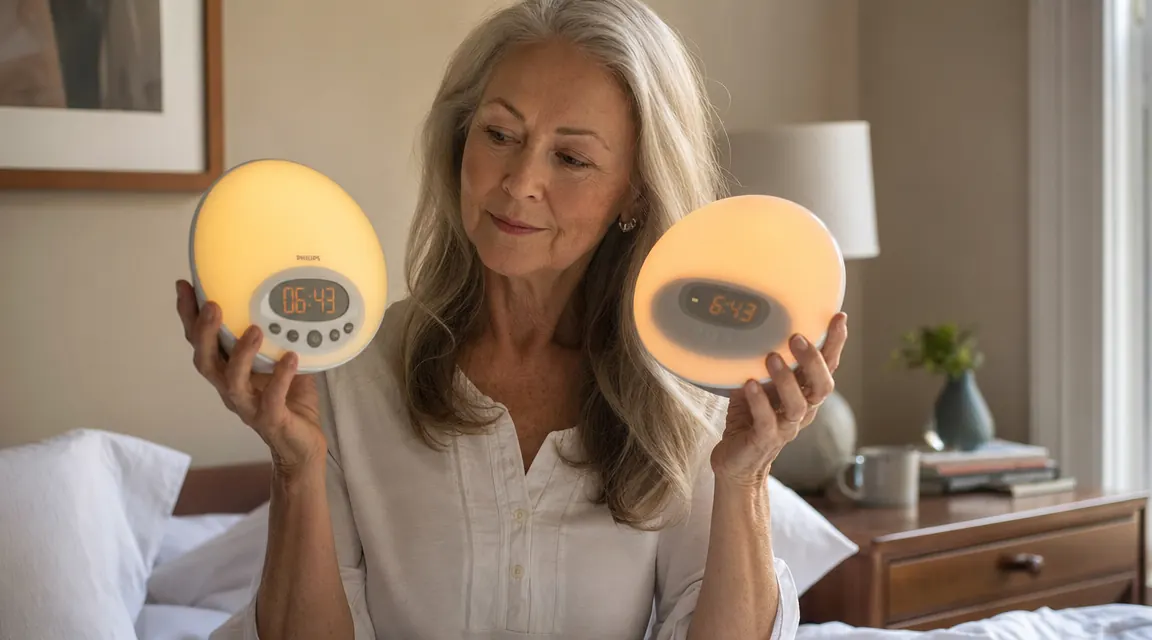
If you are shopping for a sunrise alarm clock and have done any research at all, you have probably landed on two names: the Hatch Restore 3 and the Philips SmartSleep Wake-Up Light. Both are in the mid-range. Both use gradually brightening light to wake you up gently instead of blaring a horn. And both have thousands of positive reviews. So which one do you actually buy? I used the Hatch Restore 3 for five months before sitting down to write this, and I want to give you an honest picture of what each one does well and where each one falls short.
The short answer: the Hatch Restore 3 is the better device if you want a full bedtime and wakeup routine wrapped into one product. The Philips SmartSleep is the better choice if you want something simpler, do not want to pay a monthly subscription, and just need reliable sunrise simulation without fuss. Neither is wrong. They are solving slightly different problems for slightly different people.
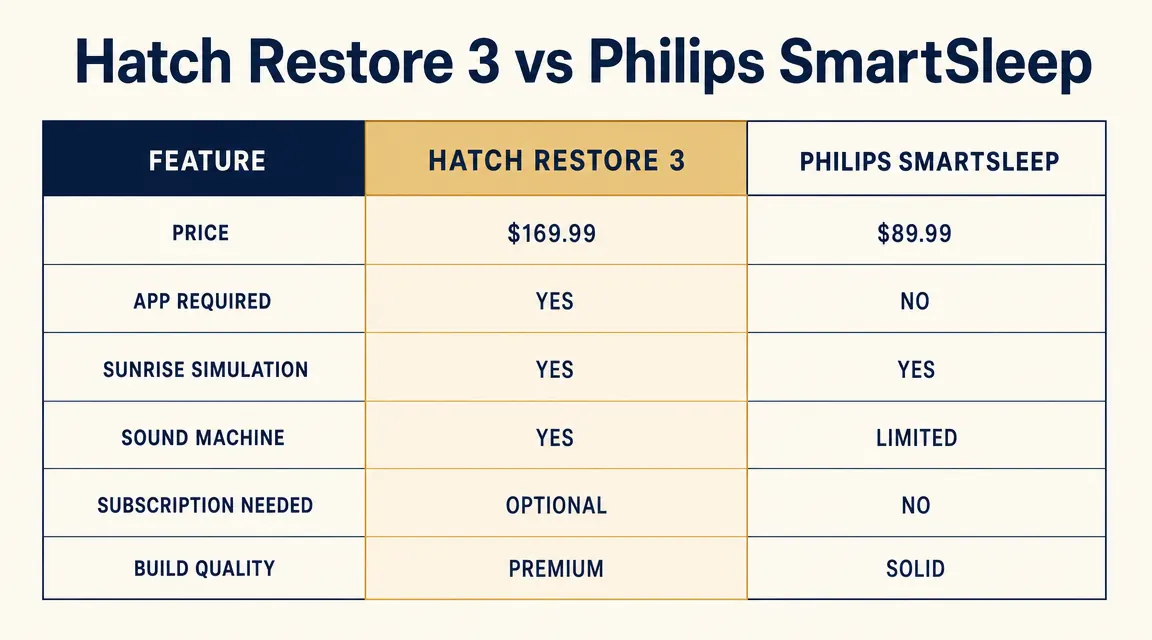
| Hatch Restore 3 | Philips SmartSleep Wake-Up Light | |
|---|---|---|
| Price (at time of writing) | Check today's price on Amazon | Check today's price on Amazon |
| Subscription required | Yes, requires monthly subscription for full library | No |
| Sunrise light simulation | Yes, 30-minute gradual warm-to-white | Yes, 30-minute gradual warm-to-white |
| Sunset wind-down light | Yes, customizable duration | Yes, fixed 30-minute session |
| Sound library | Large (nature sounds, meditations, sleep casts, music) | Small (5 nature sounds, FM radio) |
| App required for setup | Yes, all controls through app | No, physical buttons on device |
| Snooze behavior | Customizable, light dims on snooze | Standard 9-minute snooze |
| Display type | Full color touchscreen | LED ring light indicator only |
| Works without Wi-Fi | Limited (saved content only) | Fully functional |
| Best for | Full bedtime-to-wakeup routine | Simple reliable sunrise alarm |
Where the Hatch Restore 3 Wins
The Hatch is not just a wake-up light. It is a full sleep routine in one device. At night I tap the top once and it starts a 45-minute wind-down: the light shifts from bright white to dim amber, and a sleep cast (think: someone narrating a slow, boring walk through a countryside) comes on through the built-in speaker. My body has learned the pattern so well that I am usually asleep before the sleep cast ends. The Philips has a sunset mode too, but it is a simple light-dimming timer with no audio. That is a big gap for anyone who finds sound as important as light for winding down.
The sunrise simulation on the Hatch is also noticeably warmer and more customizable. I have mine set to start 30 minutes before my alarm time, beginning at a faint amber and brightening to a soft white. By the time the gentle chime plays, I am already halfway awake and feel nothing like the jolt I used to get from my phone. The Philips does the same thing, but you cannot adjust the starting brightness or the color temperature as granularly. For me personally, the sunrise quality on both is good enough that either one would improve your mornings over a phone alarm. But the Hatch gives you more knobs to turn.
By the time the Hatch chime plays, I am already halfway awake. That had never happened to me with any other alarm in sixty-plus years of getting up in the morning.
Where the Philips SmartSleep Wins
The Philips wins on simplicity and independence. Every setting is adjusted directly on the device with physical buttons. There is no app to download, no Wi-Fi to connect, no account to create. You set your wake time, pick your alarm sound, and that is it. If you are the kind of person who does not want another app on your phone, or if you share a bedroom and want something that just works without a learning curve, the Philips is genuinely easier to live with day to day.
The subscription situation is also worth taking seriously. The Hatch Restore 3 works without a subscription, but without the monthly Hatch+ plan, you lose access to most of the sound library and all of the sleep casts. You keep the sunrise alarm and a few basic sounds. That is not nothing, but it means the Hatch you actually want to use costs more than the sticker price over time. The Philips has no subscription. What you pay at checkout is the full cost, forever. Over two years, that difference adds up to a significant amount.
Still waking up groggy every morning? The Hatch Restore 3 is what I use.
After five months, the gradual sunrise light is the single biggest change I have made to my mornings. The Philips is solid, but the Hatch gives you a full bedtime routine, a better sound library, and more customization. Check today's price on Amazon before you decide.
Amazon Check Today's Price on Amazon →The Subscription Question: Is Hatch+ Worth It?
I want to spend a minute on this because I see a lot of people skip past it and then feel surprised a few weeks after buying. The Hatch Restore 3 without the Hatch+ subscription gives you: the sunrise alarm, the sunset wind-down light, one or two basic nature sounds, and the main meditation tracks. That is a usable product. But the thing that made me fall in love with the Hatch is the sleep cast library, which has hours of narrated wind-down audio that genuinely puts me to sleep faster than anything I have tried. All of that is behind the subscription.
If you already have a meditation app you love, or you sleep fine to white noise you already own, you may not need Hatch+ at all. In that case the cost comparison with the Philips tightens considerably. But if you are buying the Hatch specifically because you want the full bedtime routine, budget for the subscription. It is a monthly or annual fee. I pay the annual rate and find it worth it, but that is a personal call.
Sound Quality and the Speaker
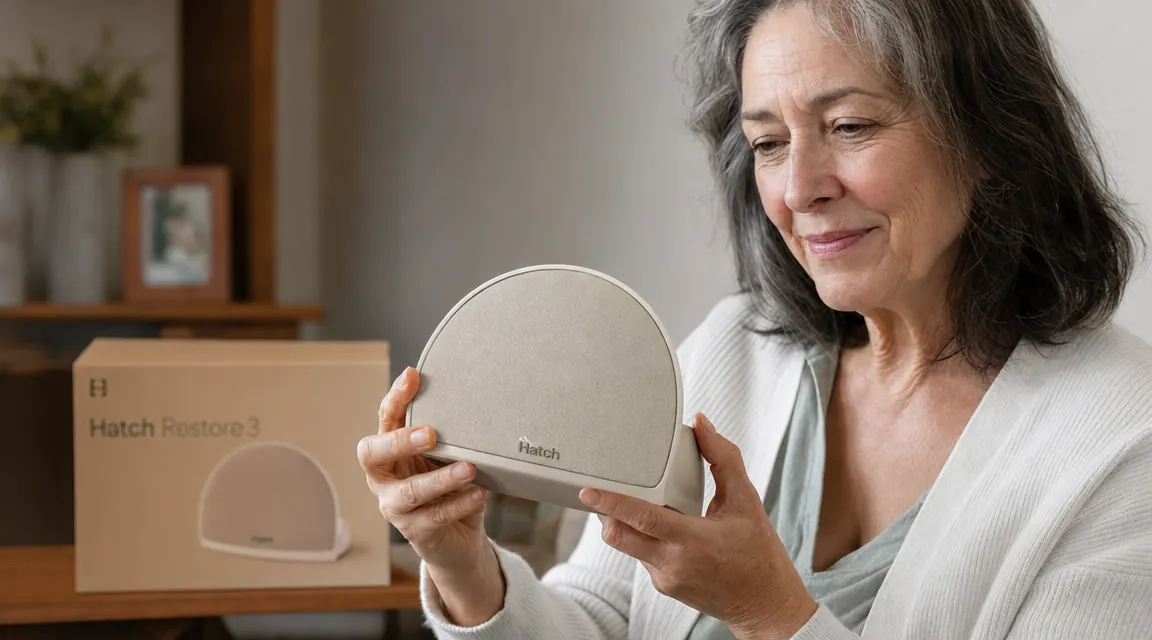
The Hatch Restore 3 has a noticeably better speaker than the Philips SmartSleep. The Philips speaker is small and tinny, fine for a rain sound in the background but not great for anything with musical depth. The Hatch speaker is warm and clear, good enough that I stopped running a separate white noise machine on my nightstand entirely. If audio quality matters to you, the Hatch wins this category without much contest.
One thing I should mention: the Hatch does not have FM radio. The Philips does. If you like waking up to a radio station, that is a real point in the Philips column. I do not personally use radio, so it was not a factor for me, but I have heard from readers who found this a dealbreaker.
App Experience and Ease of Use
I am going to be honest: setting up the Hatch Restore 3 the first time took me the better part of an hour. The app is mostly well designed, but there were a few moments where I could not find where to set my alarm time, and once where the device lost its Wi-Fi connection and I had to reconnect it from scratch. If you are comfortable with smartphones and do not mind a little setup friction upfront, you will figure it out and then forget about it. But if you are someone who just wants to plug something in and have it work, that first hour might feel frustrating.
The Philips, by contrast, is plug-in-and-go. Buttons on top of the device set the time and alarm. The display is simple. My sister-in-law who is in her seventies set hers up in about ten minutes without any help. That matters for some buyers. The Hatch is not hard to use, but it is not as intuitive as a device with physical buttons.

Who Should Buy the Hatch Restore 3
The Hatch Restore 3 is the right pick if you want more than a wake-up light. If you struggle with winding down at night, if you have never quite found the right audio for sleep, or if you want one device to anchor your whole sleep routine instead of a pile of separate tools, the Hatch delivers that. It also fits well if you are comfortable with apps and do not mind a small monthly cost for access to a premium content library. I am in my late sixties and use mine every single night. It has become as automatic as brushing my teeth.
Who Should Buy the Philips SmartSleep
The Philips is the right pick if your main goal is a reliable sunrise alarm with no subscription, no app dependency, and no ongoing cost. It is also the better choice for shared bedrooms where one partner is less tech-comfortable, for travel (no Wi-Fi needed), or for anyone who already has a separate sleep sound solution they are happy with. The sunrise simulation is real and effective, and the device itself is rock-solid. It does one thing very well and asks nothing extra of you.
The Hatch is what I reach for. Here is where to check today's price.
If you want a full bedtime and wakeup routine in one device, the Hatch Restore 3 is the one to get. Five months in, it is still the first thing I interact with when I wake up and the last thing I use before bed. Check today's price on Amazon and read what other buyers are saying.
Amazon Check Today's Price on Amazon →